

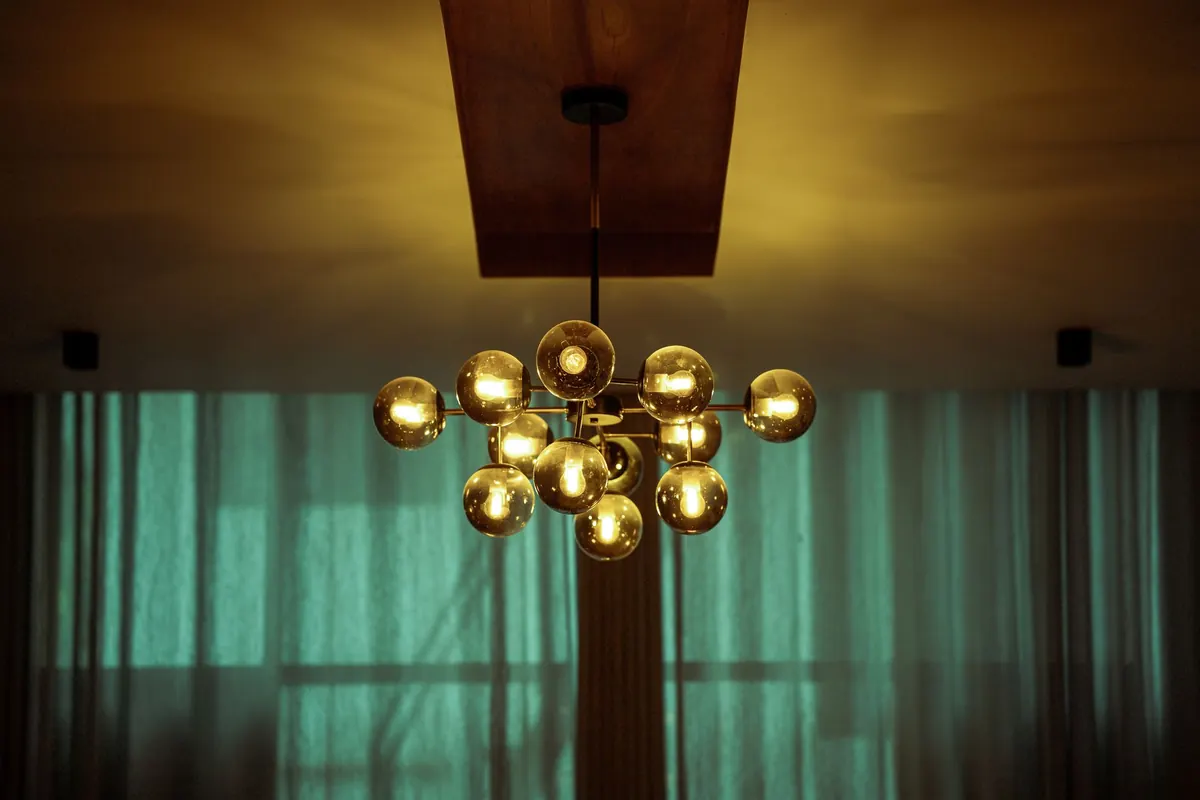
A November evening, curtains drawn, and one ceiling light blazing at full brightness — that is the moment a living room stops feeling like a retreat and starts feeling like a waiting room. The bulb in the fitting has more say in this than the paint on the walls. Colour temperature, brightness and dimming behaviour decide whether a room feels inviting or clinical, and changing a single bulb is often the cheapest, quickest way to shift it.
Colour temperature, in plain English
Colour temperature is measured in kelvin (K), and confusingly, the lower the number, the warmer the light. A candle flame sits somewhere around 1800K — a deep, amber glow. Most traditional incandescent bulbs landed near 2700K, which is why that figure is still the benchmark for warm white in British homes. Cool white begins around 4000K and takes on a crisp, slightly blue edge; daylight bulbs run from 5000K up to 6500K and are best kept for garages and workshops.
- 1800–2200K: candlelight warmth, lovely at low output, gloomy as a main light
- 2700–3000K: warm white — the natural default for living rooms, bedrooms and hallways
- 3500–4000K: cool white — clean and alert, suited to kitchens, utility rooms and offices
- 5000K+: daylight — task and security lighting, rarely flattering indoors
Those boundaries are not fixed. Two bulbs both labelled "warm white" can differ noticeably, one leaning amber and the other almost neutral, so it pays to buy the same brand and range in one go.
Warm white against cool white: what each one does to a room
Warm white flatters almost everything in a typical living room. It softens magnolia and pale grey walls, brings out the honey in oak floorboards, makes brass and copper look aged rather than shiny, and is kinder to skin tones in the mirror above the fireplace. In a north-facing room that never quite loses its grey cast, a 2700K bulb does the work of a much stronger one at 4000K, without the glare.
Cool white is doing something different: it reveals colour accurately and reads as clean, which is why it belongs over a kitchen worktop or a desk. The trade-off is that against warm materials — pine, terracotta, red brick, wool throws — it can look slightly blue and clinical. It also casts harder shadows, so a cool white bulb in a single living room lamp tends to make the corners behind the sofa feel darker than they are.
A quick test
Hold a sheet of white paper under the bulb. Warm white will tint it cream or faintly pink; cool white leaves it white or adds a hint of blue. If you are standing in the shop, that is a more reliable guide than the box.
Lumens matter more than watts now
Since LEDs took over, watts tell you about running cost, not brightness. Lumens tell you how much light actually comes out. The old 60W bulb most of us grew up with produced roughly 700–800 lumens, so that is a useful yardstick when reading labels.
The bigger point is layering. One bright fitting in the middle of the ceiling flattens a room and creates glare; three or four gentler sources at different heights give depth and shadow. Two 400-lumen table lamps, one either side of the sofa, will feel softer and more generous than a single 800-lumen pendant, even though the total output is the same.
As a rough starting point for an evening in a medium living room: keep the main ceiling light dimmable and turned down, put 400–600 lumens in each table lamp, and add a floor lamp or a pair of wall lights for fill. Anything you read by wants to sit in the 500–700 lumen range, aimed over your shoulder rather than into your eyes.
Dimming: where bulbs and switches have to agree
Dimming is what turns a functional room into a comfortable one, and it is also where most people run into trouble. An LED draws very little power, so an older dimmer designed for halogens may flicker, buzz or refuse to dim smoothly at the bottom of its range. Check that the bulb is marked dimmable, and that the dimmer is rated for LEDs — trailing-edge dimmers generally behave better with them than leading-edge models. If the light flickers at low settings, the circuit may simply be below the dimmer's minimum load; a bypass capacitor or a different switch usually solves it.
If you want the atmosphere of an old dimmer switch, look for bulbs labelled dim-to-warm. These hold their colour at full brightness and slide towards 1800–2200K as you dim, so the room warms as it darkens. It is a small feature that makes a noticeable difference at nine o'clock in the evening.
One thing to avoid: pairing a smart bulb with a wall dimmer. The bulb does its own dimming internally, and the two controls tend to fight, causing flicker or a bulb that drops out of the app.
Where cool white earns its place
None of this means banishing cool white. Fit it where you need to see clearly and work safely: under kitchen wall units, over the hob, in the utility room, above a bathroom mirror, in the garage, and at the desk if you work from home. A 4000K downlight over a kitchen island is perfectly sensible. The same bulb in a living room alcove will look and feel wrong.
Matching the room without obsessing
Buy every bulb for a room together and stick to one kelvin rating, with a colour rendering index (CRI) of at least 80 — and 90 or above for anywhere you read, paint or look at artwork. Lampshades shift the result too: a cream fabric shade warms the light further, while a white or metallic one keeps it closer to neutral. If you are gradually replacing bulbs, note the make and reference of the ones you like, because a "warm white" from a different manufacturer may not match.
An evening set-up to try tonight
- Switch off the ceiling light, or fit a dimmable 2700K bulb and turn it down to roughly a quarter.
- Bring in two lamps at different heights — one beside the sofa, one on a sideboard or shelf.
- Use 2700K bulbs at around 400–600 lumens, with the shade positioned so the bulb is hidden from eye level.
- Dim everything a step below what feels immediately comfortable, then live with it for ten minutes.
- Give it a week before buying more. Your tolerance for low light usually rises once the glare is gone.
Warm white, modest lumens and a dimmer that behaves — that combination is most of what separates a room you retreat to from one you simply pass through.
Photo: Melbin Jacob / Pexels